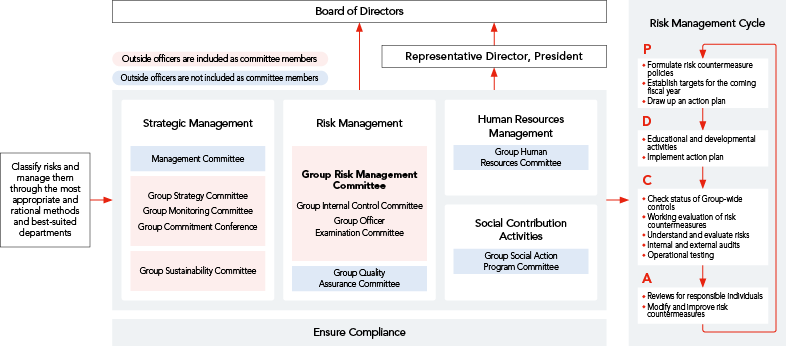
The Nichirei Group has established the Group Risk Management Committee, chaired by the representative director, president, to manage the various risks associated with its business activities in the most appropriate and rational way from a comprehensive standpoint, and to maximize the Group’s corporate value. The committee identifies and evaluates Group-wide risks, and Nichirei Corporation and its operating companies take countermeasures to these risks of their own accord based on the established risk management cycle. Important items are reported to the Board of Directors of Nichirei Corporation, which also considers countermeasures for the holding company and its operating companies.
Believing that the actions of each employee count in preventing a number of risks, Nichirei devised a Code of Conduct comprising 12 articles (revised in 2014). The code involves compliance and ethical behavior regarding the environment, society, and governance. It is designed to minimize, thorough awareness, the risk of compliance infractions and other issues.
The Group Risk Management Committee identifies and evaluates risks(including ESG), while running a risk management system for the Group. Any significant risks identified by the risk management process are reported to the holding company’s board of directors for discussion.
| Risk Category | Risks | Countermeasures and Initiatives | Management System |
|---|---|---|---|
| 1.Economic conditions and business environment |
|
|
|
| 2.Food quality issues |
|
|
|
| 3.Securing and developing diverse human resources |
|
|
|
| 4.Information security |
|
|
|
| 5.Price fluctuations of commodities and raw materials |
|
|
|
| 6.Fluctuations in crude oil prices, etc. |
|
|
|
| 7.Impact of exchange rate fluctuations |
|
|
|
| 8.Changes in laws and regulations, etc. |
|
|
|
| 9.Sustainable food procurement |
|
|
|
| 10.Climate change |
|
|
|
| 11.Large-scale natural disasters |
|
|
|
| 12.International situation |
|
|
|
| 13. Technological innovation |
|
|
|
| 14.Holding of fixed assets |
|
|
|
| 15.Crossshareholdings |
|
|
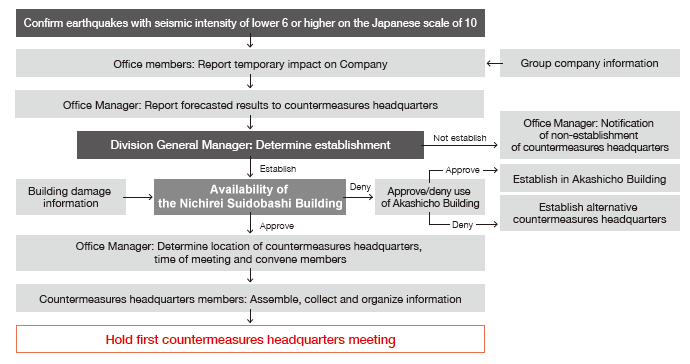
We have introduced a Company-wide safety confirmation system. In the event of a disaster, such as an earthquake with an intensity of five or higher, messages will be sent via email to employees to check whether they are safe, and relevant local information will be provided promptly on a dedicated website. The website allows for the rapid collection and sharing of information. To ensure that all individuals, including newly hired employees, receive email notifications and can report promptly, the Nichirei Group conducts safety confirmation drills twice a year across the entire Group in Japan.
In addition, Crisis management drills are conducted approximately once a year with the participation of representatives from the holding company and key subsidiaries. For example, drills are conducted to confirm whether actions can be taken in accordance with the BCP manual, such as establishing a crisis management headquarters at an alternate location in the event of a major earthquake in Tokyo that halts the functions of the headquarters.
Nichirei Foods has established a production system at multiple sites for some of its core products. Taking the example of Honkaku-Itame Chahan (fried rice), production is carried out at the Funabashi Plant in eastern Japan and at Kyurei in western Japan, in order to both strengthen production capacity and enhance BCP.
In order to ensure the safety of business travelers, employees posted overseas and their families against various risks overseas, such as incidents, accidents, and natural disasters, the Nichirei Group manages and implements an Overseas Crisis Response Manual, which provides background knowledge and stipulates procedures and frameworks for responding to crises.
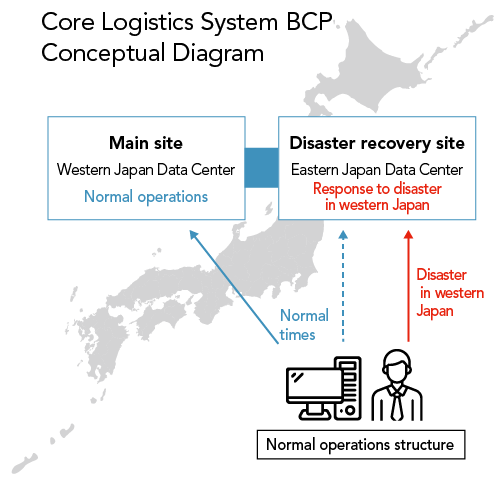
The Group’s main core system is redundant for the purpose of business continuity, and includes a disaster recovery (DR) system. Specific examples are as follows.
Nichirei Logistics Group has constructed DR that assumes that its data center is affected, as BCP support for its core logistics system. The company can quickly resume operations through the use of two sites, which allows it to switch from its main site to the DR site in the event of a large-scale disaster.
Approximately one hour will be needed from the activation of DR to online restart. It is designed to ensure that impacts on customer businesses and food distribution will be limited to the minimum in various circumstances. Nichirei Logistics Group plans to implement advanced initiatives to provide a food logistics lifeline that will contribute to the business continuity of its business partners.
In recent years, with a number of areas having experienced enormous damage as a result of natural disasters, the Nichirei Logistics Group has formulated a BCP to be implemented in the event of earthquakes, tsunamis, typhoons, major storms, and floods. Such risk management prioritizes ensuring the safety of employees and cargo being handled.
Every year before the typhoon season, in addition to circulating a document detailin our anticipated response to forecast typhoons and other weather-related disasters on the Company website, we provide business partners with information on how to deal with temporary closures and changes in business hours.