G

Risk Management

Basic Philosophy

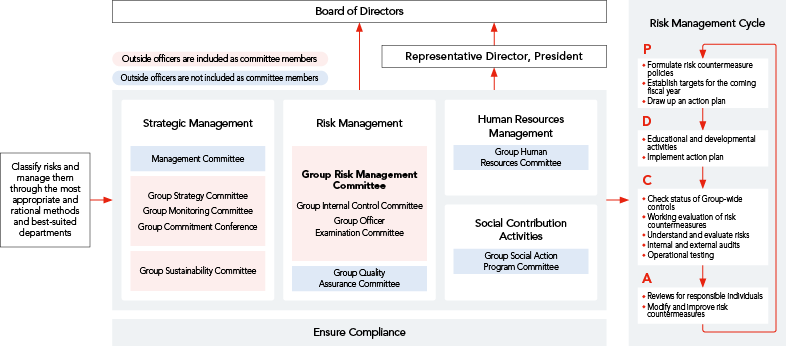
The Nichirei Group has established the Group Risk Management Committee, chaired by the representative director, president, to manage the various risks associated with its business activities in the most appropriate and rational way from a comprehensive standpoint, and to maximize the Group’s corporate value. The committee identifies and evaluates Group-wide risks, and Nichirei Corporation and its operating companies take countermeasures to these risks of their own accord based on the established risk management cycle. Important items are reported to the Board of Directors of Nichirei Corporation, which also considers countermeasures for the holding company and its operating companies.

Nicihrei Corporation, Strategic Planning, Nichirei Corporation, Quality Assurance Division, Nichirei Corporation, Technology Management, Nichirei Corporation, Corporate Internal Audit, Nichirei Corporation, Corporate Supervise, Nichirei Corporation, Legal Affairs, Nichirei Corporation, Human Resources Strategy & General Affairs, Nichirei Corporation, Finance & Investor Relations, Nichirei Corporation, Accounting & Tax, Nichirei Corporation, Group Communication, Nichirei Foods Inc., Nichirei Fresh Inc., Nichirei Logistics Group Inc., Nichirei Biosciences Inc., Hitachi Foods & Logistics Systems,Inc., NIchirei Bisiness Partners .inc

Management System

Believing that the actions of each employee count in preventing a number of risks, Nichirei devised a Code of Conduct comprising 12 articles (revised in 2014). The code involves compliance and ethical behavior regarding the environment, society, and governance. It is designed to minimize, thorough awareness, the risk of compliance infractions and other issues.
The Group Risk Management Committee identifies and evaluates risks(including ESG), while running a risk management system for the Group. Any significant risks identified by the risk management process are reported to the holding company’s board of directors for discussion.
Important Risks and Countermeasures of the Nichirei Group

Risk Category Risks Countermeasures and Initiatives Management System
1.Economic conditions and business environment
  • Market in Japan: Long-term contraction of total demand due to declining population/new demand due to changes in household composition and lifestyles
  • Overseas markets: Rise of different needs in each region underpinned by factors including economic growth
  • Growing expectations and demands for the achievement of a sustainable society
  • Promotion of innovation and creation of new value to solve social issues
  • Strategic management
2.Food quality issues
  • Food quality problems, such as not meeting sanitation and pesticide and animal drug residue standards, contamination by foreign or toxic substances, inadequate labeling of allergenic substances and environmental pollutants (PFAS)
  • Occurrence of large-scale product recalls
  • Introduction of a food safety management system
  • Appropriate quality and production control of raw materials and products, traceability system, food defense, and training and proper allocation of personnel
  • Group Quality Assurance Committee
3.Securing and developing diverse human resources
  • Securing and developing the necessary human resources
  • A serious quality problem with a food product outside of our Group could also hinder the stable procurement and sales of merchandise, and raw materials, and could reduce the utilization rate of logistics centers
  • Responding to labor shortages due to Japan’s declining birthrate and aging population
  • Improving Employee Engagement
  • Development of overseas human resource candidates, and hiring foreign nationals studying in Japan as new graduates
  • Promotion of health management
  • Realizing diverse work styles
  • Group Human Resources Committee
4.Information security
  • System outages, leakage or falsification of important information due to operational problems or cyberattacks in systems used for business purposes
  • Establishment of firewalls and intrusion detection and authentication systems
  • Establishment of internal rules and regulations, e-learning and other training for employees, and an information management structure
  • Group Risk Management Committee
5.Price fluctuations of commodities and raw materials
  • Significant fluctuations in raw material prices (including marine, meat and poultry products) due to market conditions, yields and hauls
  • Cost reduction through productivity improvements
  • Development of new value-added products and expansion of distinctive products
  • Procurement and sales balanced with supply and demand
  • Strategic management
6.Fluctuations in crude oil prices, etc.
  • Increase in electricity, diesel oil, heavy oil, and other fuel procurement costs due to soaring crude oil prices; increase in procurement costs of commodities and raw materials
  • Cost reductions through the introduction of new technologies and improvement of operations
  • Strategic management
7.Impact of exchange rate fluctuations
  • Fluctuations in currencies including the U.S. dollar, Thai baht and euro that impact procurement prices of commodities and raw materials, as well as the impact of currency translation on the results of overseas subsidiaries
  • Use of forward exchange contracts, etc.
  • Strategic management
8.Changes in laws and regulations, etc.
  • Changes in laws, regulations and soft laws in Japan and overseas
  • Monitoring of trends in laws and regulations in each country and region, and thorough compliance with such laws and regulations
  • Strategic management
9.Sustainable food procurement
  • Growing social demands for consideration of human rights and the workplace environment in the supply chain, management of natural marine resources, reduction of food loss, and resolution of the marine plastic problem, as well as changes in and establishment of laws, regulations and soft laws
  • Difficulty in ensuring stable procurement of raw materials and other resources or damage to social credibility due to inadequate efforts or those deemed insufficient
  • Development of a Sustainable Procurement Policy, Supplier Code of Conduct and Supplier Guidelines, and implementation of supplier ESG surveys and joint human rights due diligence
  • Handling of MSC/ASC-certified marine products
  • Implementation of initiatives related to the procurement of sustainable palm oil and conducting of a sustainable cycle poultry business
  • Group Sustainability Committee
10.Climate change
  • Social demand for reduction of greenhouse gas emissions, and strengthening of regulations such as the imposition of a carbon tax and other policies (our fundamental technologies are for freezing and refrigeration, and we consume energy, mainly electricity)
  • Impact of rising temperatures and extreme weather associated with global warming on supply chains, including raw material procurement, production, and logistics
  • Switching from fluorocarbon to natural coolants, introduction of renewable energy use, such as expanding the installation of solar power generation facilities, the implementation of off-site corporate PPA and the use of Tradable Green Certificates
  • Ongoing climate change impact assessment and information disclosure in accordance with TCFD recommendations
  • Group Sustainability Committee
11.Large-scale natural disasters
  • Extensive damage to roads, ports and railroads at or near the Group’s sites, market contraction, supply chain disruptions, or restrictions on business activities due to factors such as a massive earthquake or localized rain storms
  • Seismic retrofitting work; deployment of emergency generators; establishment of an employee safety confirmation system, disaster prevention manuals and business continuity plans (BCPs); and use of multiple data centers
  • Group Risk Management Committee
12.International situation
  • Rising energy and raw material prices
  • Impact on financial markets
  • Impact on supply chains
  • Close monitoring of situations and minimization of their impact on business activities
  • Strategic management
13. Technological innovation
  • Decline in competitiveness of the Group’s technologies and products and services due to technological innovations, including rapid progress in digital technologies and food tech
  • Reform of business processes and promotion of innovation through the use of digital technologies and data
  • Implementation of an innovation management system based on ISO 56002
  • Strategic management
14.Holding of fixed assets
  • Impairment loss due to deterioration of conditions at logistics centers caused by relocation of shipping companies and changes in road transportation networks
  • Impairment loss due to aging and obsolescence of equipment at production plants or poor sales
  • Impairment and write-down of goodwill and investment securities due to deviation from the business plan at the time of investment
  • Clarification of items for consideration when preparing investment plans, and the rules for post-investment verification
  • Strategic management
15.Crossshareholdings
  • Significant changes in the market value of cross-shareholdings or in the financial position of the issuing company
  • Yearly report to the Board of Directors
Nicihrei Corporation, Strategic Planning, Nichirei Corporation, Quality Assurance Division, Nichirei Corporation, Technology Management, Nichirei Corporation, Corporate Internal Audit, Nichirei Corporation, Corporate Supervise, Nichirei Corporation, Legal Affairs, Nichirei Corporation, Human Resources Strategy & General Affairs, Nichirei Corporation, Finance & Investor Relations, Nichirei Corporation, Accounting & Tax, Nichirei Corporation, Group Communication, Nichirei Foods Inc., Nichirei Fresh Inc., Nichirei Logistics Group Inc., Nichirei Biosciences Inc., Hitachi Foods & Logistics Systems,Inc., NIchirei Bisiness Partners .inc

Initiatives

Business Continuity Plan Initiatives

Employee Safety
Confirming Safety in Emergency Situations

We have introduced a Company-wide safety confirmation system. In the event of a disaster, such as an earthquake with an intensity of five or higher, messages will be sent via email to employees to check whether they are safe, and relevant local information will be provided promptly on a dedicated website. The website allows for the rapid collection and sharing of information. To ensure that all individuals, including newly hired employees, receive email notifications and can report promptly, the Nichirei Group conducts safety confirmation drills twice a year across the entire Group in Japan.
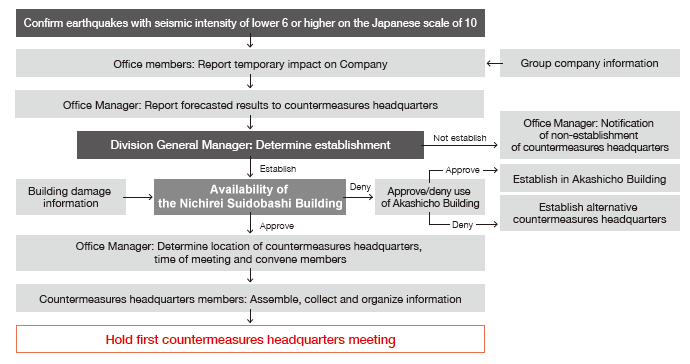
In addition, Crisis management drills are conducted approximately once a year with the participation of representatives from the holding company and key subsidiaries. For example, drills are conducted to confirm whether actions can be taken in accordance with the BCP manual, such as establishing a crisis management headquarters at an alternate location in the event of a major earthquake in Tokyo that halts the functions of the headquarters.

Domestic Production System for Frozen Foods

Nichirei Foods has established a production system at multiple sites for some of its core products. Taking the example of Honkaku-Itame Chahan (fried rice), production is carried out at the Funabashi Plant in eastern Japan and at Kyurei in western Japan, in order to both strengthen production capacity and enhance BCP.

Overseas Crisis Management

In order to ensure the safety of business travelers, employees posted overseas and their families against various risks overseas, such as incidents, accidents, and natural disasters, the Nichirei Group manages and implements an Overseas Crisis Response Manual, which provides background knowledge and stipulates procedures and frameworks for responding to crises.

Information Systems

The Group’s main core system is redundant for the purpose of business continuity, and includes a disaster recovery (DR) system. Specific examples are as follows.

Enhancing the BCP for Our Core Logistics System

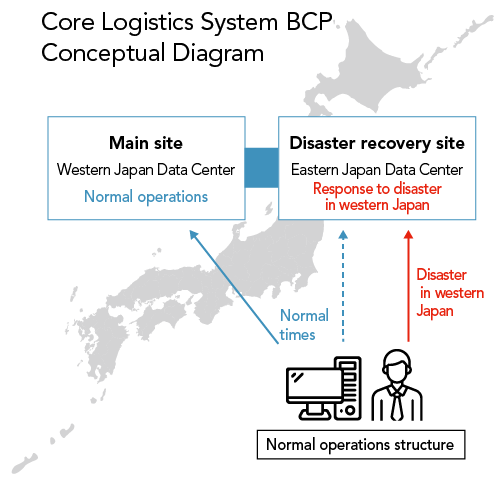
Nichirei Logistics Group has constructed DR that assumes that its data center is affected, as BCP support for its core logistics system. The company can quickly resume operations through the use of two sites, which allows it to switch from its main site to the DR site in the event of a large-scale disaster.
Approximately one hour will be needed from the activation of DR to online restart. It is designed to ensure that impacts on customer businesses and food distribution will be limited to the minimum in various circumstances. Nichirei Logistics Group plans to implement advanced initiatives to provide a food logistics lifeline that will contribute to the business continuity of its business partners.
Logistics Core System BCP Conceptual Diagram

Case StudyNichirei Logistics Group BCP Initiatives
Overview

In recent years, with a number of areas having experienced enormous damage as a result of natural disasters, the Nichirei Logistics Group has formulated a BCP to be implemented in the event of earthquakes, tsunamis, typhoons, major storms, and floods. Such risk management prioritizes ensuring the safety of employees and cargo being handled.
Every year before the typhoon season, in addition to circulating a document detailin our anticipated response to forecast typhoons and other weather-related disasters on the Company website, we provide business partners with information on how to deal with temporary closures and changes in business hours.
Countermeasures Headquarters Establishment Flow

Countermeasures Headquarters Establishment Flow

Nicihrei Corporation, Strategic Planning, Nichirei Corporation, Quality Assurance Division, Nichirei Corporation, Technology Management, Nichirei Corporation, Corporate Internal Audit, Nichirei Corporation, Corporate Supervise, Nichirei Corporation, Legal Affairs, Nichirei Corporation, Human Resources Strategy & General Affairs, Nichirei Corporation, Finance & Investor Relations, Nichirei Corporation, Accounting & Tax, Nichirei Corporation, Group Communication, Nichirei Foods Inc., Nichirei Fresh Inc., Nichirei Logistics Group Inc., Nichirei Biosciences Inc., Hitachi Foods & Logistics Systems,Inc., NIchirei Bisiness Partners .inc