Nichirei Group Materiality

Group Material Matters

Long-term Management Goal “N-FIT (Nichirei Future Innovative Tactics) 2035”

Towards 2035 (Long-term management goal)

Nicihrei Corporation, Strategic Planning, Nichirei Corporation, Quality Assurance Division, Nichirei Corporation, Technology Management, Nichirei Corporation, Corporate Internal Audit, Nichirei Corporation, Corporate Supervise, Nichirei Corporation, Legal Affairs, Nichirei Corporation, Human Resources Strategy & General Affairs, Nichirei Corporation, Finance & Investor Relations, Nichirei Corporation, Accounting & Tax, Nichirei Corporation, Group Communication, Nichirei Foods Inc., Nichirei Fresh Inc., Nichirei Logistics Group Inc., Nichirei Biosciences Inc., Hitachi Foods & Logistics Systems,Inc., NIchirei Bisiness Partners .inc

Group Material Matters

In 2020, the Nichirei Group identified five material matters (materiality) and set a vision for each of them in order to achieve its previous long-term management goals for 2030. We are carrying on the materiality concept in our new long-term management goal “N-FIT 2035.” We are promoting sustainability management by executing measures that address the material matters while balancing social and economic value.

We will leverage our strengths as we develop business in fields that support good eating habits and health and work on the following five material matters.
Material Matters (Materiality) Vision for 2030 Group Measures Group KPIs for FY2031
1 Creating new value in food and health Create new markets and customer value by taking on challenges outside existing areas in both food and health Discover the potential of materials and cooling power to contribute to the future of the Earth and people’s mental and physical health through food
  • Allocate resources to R&D to investigate health, the global environment and diversifying customer value, as well as to marketing
  • Develop products and services and convey information to address people’s mental and physical health and the global environment
  • Establish mechanisms to create and cultivate value in new fields and conduct innovation activities
  • Sales of products and services that create added value for people’s mental and physical health and for the global environment*1: ¥140.0 billion
  • People provided with information for good eating habits and health (total number of people per year): maintain over 200 million
2 Strengthening food processing and production technology capabilities; enhancing logistics services Further refine core competencies in food processing, production and logistics to resolve social issues and improve profitability through competitive advantages in global markets Ability to generate cash improved by concentrating management resources on core businesses Promote capacity expansion, work process innovation, reduction of environmental impact, and development of business foundations through proactive capital expenditures in the processed foods and temperature-controlled logistics businesses
  • EBITDA margin: 12%
  • EBITDA CAGR: 7% or higher
  • *FY2022 is the baseline for FY2025 and FY2026 CAGR, FY2031 CAGR is the CAGR for FY2026–FY2031
Overseas business as a new pillar of earnings Accelerate overseas expansion by securing and training globally capable human resources, cultivating partner companies, conducting M&A and other means
  • Overseas sales ratio: 35.0%
3 Realizing sustainable food procurement and a circular economy Resolving various social issues related to the supply chain, which is the foundation of our business, and contribute to sustainable food procurement and the realization of a circular economy All raw materials and ingredients are procured from suppliers and partner companies that comply with the Nichirei Group Supplier Code of Conduct and Supplier Guidelines Establish a supply chain with consideration for human rights and the environment and conduct due diligence
  • Rate of procurement from suppliers and OEMs that comply with the Nichirei Group Supplier Code of Conduct and Supplier Guidelines*2: Rate of implementation of communication with main suppliers and OEMs 100%
  • Rate of implementation of ESG due diligence for main raw materials and main suppliers: 100%
Promoting a circular economy by creating new business models Work to conduct sustainable resource procurement and help to realize a circular economy
  • Rate of attendance for the SDGs education program aimed at realizing a circular economy: 100% (all employees)
  • Rate of waste recycling at all sites: 99%
  • Procurement ratio of sustainable marine products complying with the Nichirei Group Sustainable Marine Product Procurement Guidelines in marine products business: 100%
  • Ratio of marine products in the above from fisheries with MSC, ASC or other global certification: 50%
  • Procurement ratio of sustainable Palm oil (RSPO certified oil) : 100% (Certified oil)
Understanding risks to natural capital and improving resilience related to biodiversity and water resources Conserve biodiversity and water resources through business activities that consider ecosystems
  • Reduce water consumption at high-risk locations and implement water conservation activities
  • Engage in biodiversity restoration activities, including the preservation of plant and animal species at Group sites
4 Climate change initiatives As a food and logistics company that is greatly affected by climate change, we will work with stakeholders to counter global warming and reduce energy consumption throughout the supply chain Efforts underway to reduce CO₂ emissions both inside and outside the Group toward the goal of becoming carbon neutral by 2050 Reduce CO₂ emissions per unit of production and utilize renewable energy at food factories and logistics centers, and disclose information based on the TCFD recommendations
  • Reduction in CO₂ emissions: -42% (Compared with FY2023; Scope 1 and 2 in Japan and Overseas)
  • Reduction in CO₂ emissions: -25% (Compared with FY2023; Scope 3 in Japan and Overseas)
Elimination of CFCs progressing at production and logistics facilities as a global warming countermeasure
  • Replace all refrigerants used in freezing and refrigerating equipment in Japan with natural refrigerants
  • Switch to natural refrigerants overseas as necessary, based on on-site confirmation
  • Rate of conversion to natural refrigerants Production equipment (Japan): 100%
  • Rate of conversion to natural refrigerants (temperature-controlled logistics (including overseas))*3 :80%
5 Securing and developing a diverse array of human resources Secure and develop diverse human resources and foster an inclusive corporate culture to achieve sustainable growth Diverse human resources with various characteristics and skills, maximizing their potential to improve their job satisfaction and support the sustainable growth of the Group
  • Conduct a Company-wide employee engagement survey to monitor the effectiveness of measures
  • Establish a personnel system that enables Group employees to choose work styles according to their career outlook and contributes to productivity improvement
  • Establish and provide support for application of rules
  • Employee engagement score 80pt
  • Ratio of women directors and women Audit & Supervisory Board members (Holding company): 30% or higher
  • Ratio of female employees in management positions (in major Group companies in Japan)*4 : 30%
  • Promote communication activities and impartially provide learning opportunities in order to create a work environment and corporate culture in which employees are healthy, lively and satisfied with their jobs
  • Investment in human resources \2.0 billion
  • *1 Examples of relevant products
    Nichirei Foods: Products with health value (everyOne meal and Kikubari-Gozen), personal use (Hiyashi-Chuka and Kobashi-Men-no-Gomoku-Ankake-Yakisoba), Amani-no-Megumi series, Junwakei, etc.
  • *2The Group targets and KPIs related to supply chain management were revised at the Board of Directors meeting held on February 18, 2025.
  • *3The target for the rate of conversion to natural refrigerants (temperature-controlled logistics) in 2030 was revised from 75% to 80% at the Board of Directors meeting held on February 18, 2025.
  • *4The scope of the measurement for the ratio of female employees in management positions was revised from the holding company only to the Group (main Group companies in Japan) at the Board of Directors meeting held on October 15, 2024.
Nicihrei Corporation, Strategic Planning, Nichirei Corporation, Quality Assurance Division, Nichirei Corporation, Technology Management, Nichirei Corporation, Corporate Internal Audit, Nichirei Corporation, Corporate Supervise, Nichirei Corporation, Legal Affairs, Nichirei Corporation, Human Resources Strategy & General Affairs, Nichirei Corporation, Finance & Investor Relations, Nichirei Corporation, Accounting & Tax, Nichirei Corporation, Group Communication, Nichirei Foods Inc., Nichirei Fresh Inc., Nichirei Logistics Group Inc., Nichirei Biosciences Inc., Hitachi Foods & Logistics Systems,Inc., NIchirei Bisiness Partners .inc

Connection between Non-financial Measures and Corporate Value Enhancement

Nichirei believes that enhancing corporate value requires initiatives that improve profitability (ROIC, ROE), reduce capital costs (WACC), and promote growth expectations (PER). We view the execution of measures to address our material matters as contributing to the improvement of these three types of economic value, thereby enhancing corporate value. By continuing to promote non-financial measures that address our material matters, we will create both economic and social value, which will ultimately enhance corporate value.
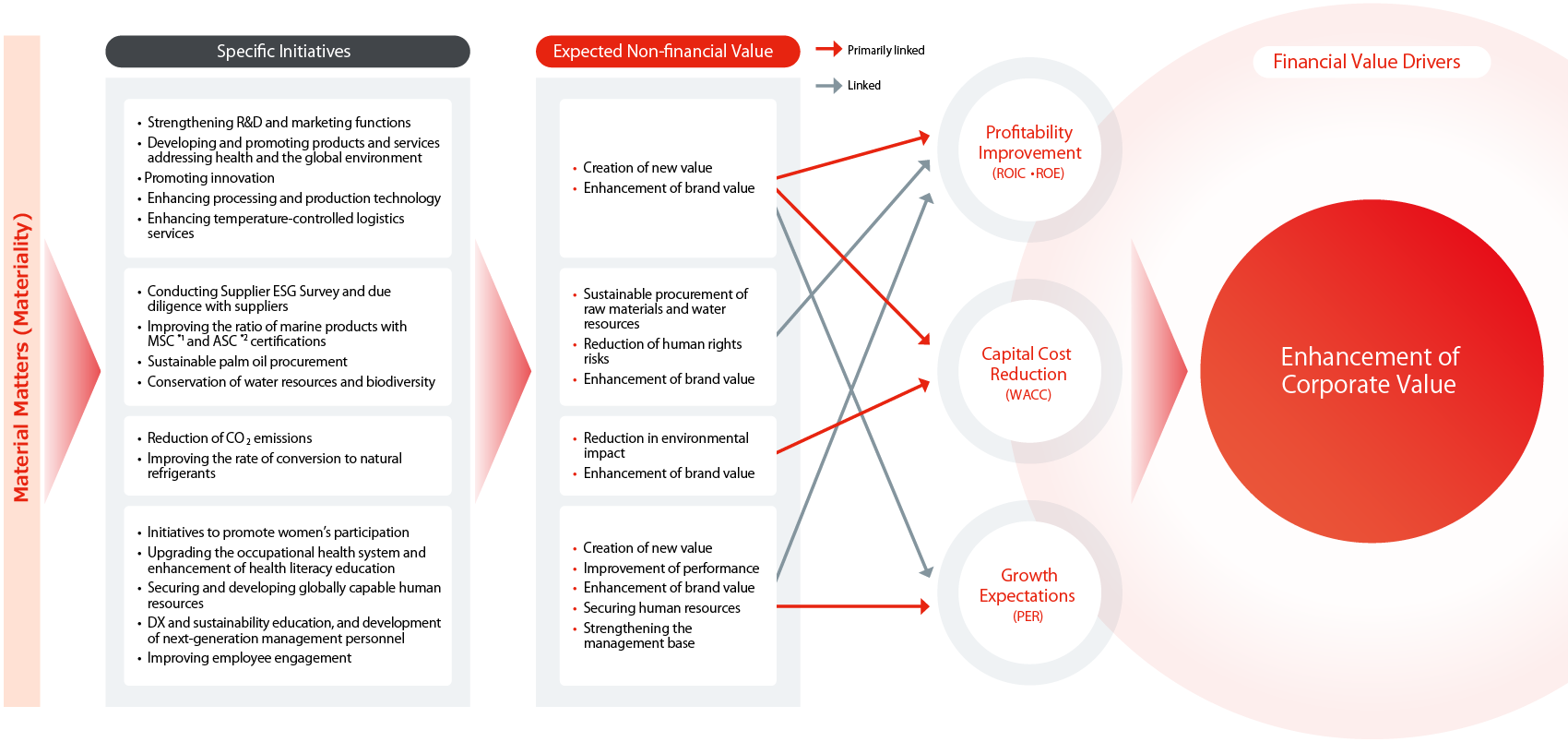
Connection between Non-financial Measures and Corporate Value Enhancement

  • *1MSC certification: Certification of sustainable natural marine products by MSC (Marine Stewardship Council)
  • *2ASC certification: Certification of sustainable aquaculture products by ASC (Aquaculture Stewardship Council)